AI for structural and seismic engineering
Machine-learning methods for structural response prediction, damage classification, building inventory generation, and rapid post-event assessment.
Read more → Data-AI-Resilience LabNational Central UniversityGoogle Scholar ↗
Department of Civil Engineering · National Central University
Data-driven methods for safer and more resilient infrastructure
OUR APPROACH
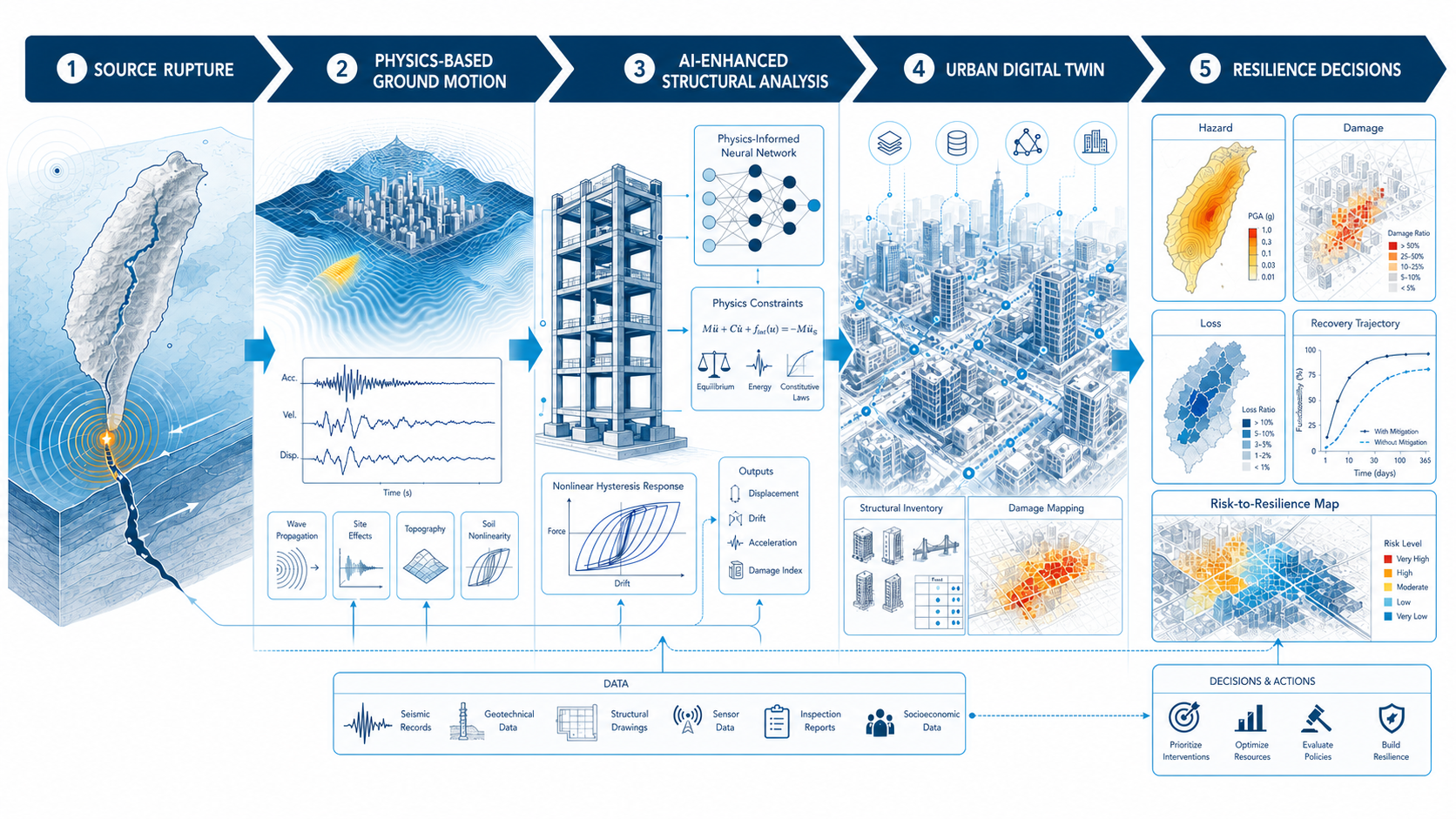
Our research integrates physics-driven AI computational methods and digital twin technologies across the full earthquake engineering chain—from earthquake source rupture and ground-motion simulation to nonlinear structural analysis, urban damage assessment, and resilience-informed decisions.
RESEARCH THEMES
Machine-learning methods for structural response prediction, damage classification, building inventory generation, and rapid post-event assessment.
Read more →Physics-based ground motions, fragility analysis, and regional building data to quantify risk across buildings, communities, and cities.
Read more →Frameworks for understanding how infrastructure systems withstand, adapt to, and recover from hazards—and how analysis can inform action.
Read more →LATEST PUBLICATION
W. Zhang, M.-C. Hsieh, P.-Y. Chen · Seismological Research Letters · 2026