RESEARCH PROGRAM

Research

We combine mechanics, artificial intelligence, and high-performance computing to study infrastructure performance from individual components to entire cities.

WHY IT MATTERS

Engineering insight that scales.

High-fidelity nonlinear analysis is essential—but applying it to tens of thousands of buildings is computationally demanding.

Our work develops scientifically grounded AI and automation strategies that retain important physical behavior while expanding the scale, speed, and accessibility of structural and regional risk analysis.

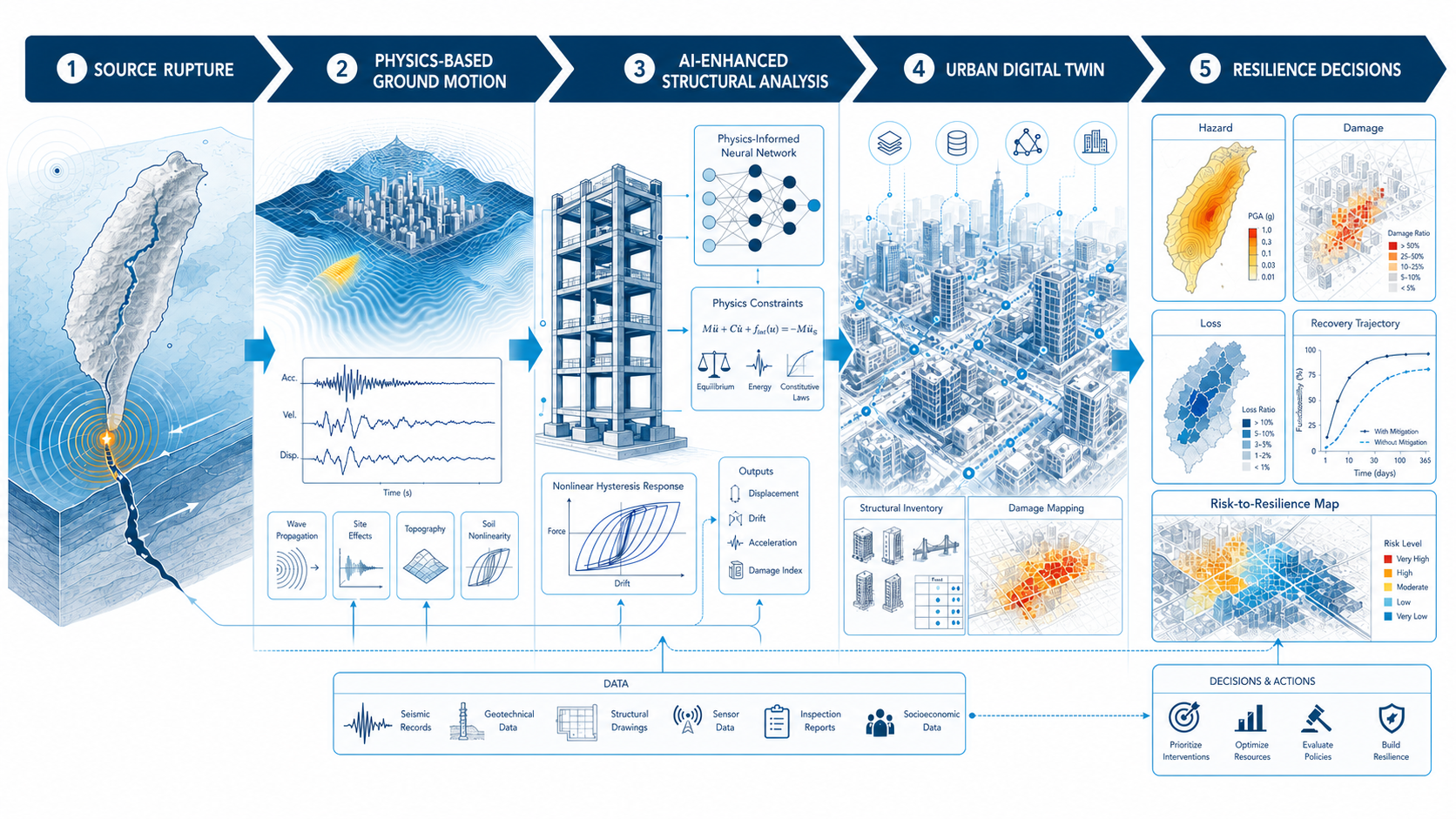
Research framework from earthquake source rupture through physics-based ground motion and AI-enhanced structural analysis to urban digital twins and resilience decisions
Physics-Driven Artificial Intelligence and Digital Twin Technologies: From Earthquake Source Rupture Simulation to Urban Seismic Resilience Assessment

CORE THEMES

Where we focus

01

AI for structural and seismic engineering

Machine-learning methods for structural response prediction, damage classification, building inventory generation, and rapid post-event assessment.

  • Physics-informed AI
  • Deep learning
  • Computer vision
  • 3D point clouds
02

Earthquake risk and regional loss

Physics-based ground motions, fragility analysis, and regional building data to quantify risk across buildings, communities, and cities.

  • Seismic fragility
  • Regional simulation
  • Loss assessment
  • Ground motions
03

Infrastructure resilience

Frameworks for understanding how infrastructure systems withstand, adapt to, and recover from hazards—and how analysis can inform action.

  • Resilience metrics
  • Digital twins
  • Decision support
  • Climate hazards

RESEARCH WORKFLOW

From data to decisions

01

Observe

Street-view imagery, 3D point clouds, sensor records, structural drawings, ground motions, and regional building data.

02

Model

Automated inventories, nonlinear structural models, physics-based simulations, and probabilistic fragility representations.

03

Learn

Deep learning, active learning, generative models, graph neural networks, and transfer learning constrained by engineering knowledge.

04

Assess

Building response, collapse risk, regional loss, recovery, and infrastructure resilience at scales useful for decision-making.

COLLABORATION

Bring data, methods, and real-world problems together.

We welcome collaboration in structural engineering, AI, statistics, earth science, computing, and urban resilience.

Start a conversation →